
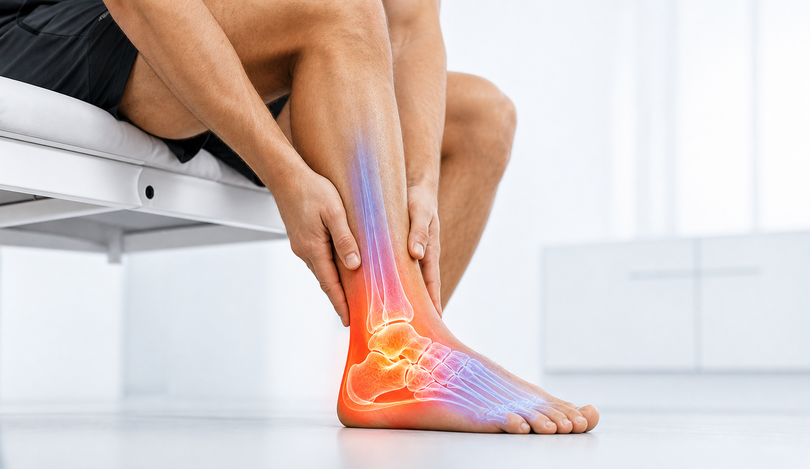
SPINE CONDITION

Athletic & Performance Injuries

Athletic and performance injuries can bench you right when you're building momentum — the training block you were finally sticking to, the season you didn't want to miss, a personal record you were closing in on. The instinct to push through is usually right but in rare instances is what turns a manageable injury into a much longer layoff. Small changes made early can be the difference between missing two weeks and missing a season, and treating an injury upstream — before compensation patterns set in or a tissue is pushed past what it can handle — keeps you closer to full performance, not further from it. At Wellward, we don't guess based on where it hurts or what the MRI shows. We find the real source first, and build your return around it.

Does This Sound Familiar?

Athletic and performance pain can feel like a nagging ache that shows up every time you train, a sharp pain after a specific play or lift, or a nagging sense that you're not moving quite right even when nothing hurts outright. It can flare during a specific movement — a throw, a cut, a landing — and fade just enough between sessions that it's easy to ignore.

It doesn't just change how you train. It changes your confidence in your body, whether you push through or hold back, whether you trust your body to do what you ask of it. When you start modifying how you play because of it, it's time to get answers.

If several of the statements feel familiar, the next step is not guessing. It may be time for a more complete evaluation of what is actually driving your pain.

Do you…

If several of these feel familiar, the next step isn't guessing — it's a real answer.

  • Keep training through a pain that shows up at the same point in every session?
  • Notice one side feels weaker, tighter, or less coordinated than the other?
  • Feel like your last "minor" injury never fully went away?
  • Hesitate before a specific movement — a cut, a jump, a throw — because of how it might feel?
  • Feel like no one has fully explained why you feel as bad as you do?

What Causes Athletic & Performance Injuries?

Performance injuries usually start one of two ways: a specific incident — a collision, an awkward landing, a bad rep — or the slow accumulation of training load that finally outpaces what your tissue can recover from.

Either way, your body starts protecting itself: compensating with other muscles, changing your mechanics, favoring one side. That's a smart short-term response, but over time it just moves the load somewhere else — often turning a single overloaded structure into two or three compensating ones. And confusingly, where you feel it may not be where the problem actually started.

Overuse / Repetitive Load

Training volume or frequency outpaces your tissue's ability to recover — common in runners, throwers, and lifters.

Acute Traumatic Injury

A specific incident — a collision, an awkward landing, a sudden pivot — that damages tissue in one moment.

Biomechanical / Form Breakdown

Movement patterns or muscle imbalances that put abnormal load on a joint or tissue over time.

Return-Too-Soon Reinjury

Going back to full activity before tissue has actually healed, often turning a minor injury into a chronic one.

Recovery & Load Management Deficits

Inadequate sleep, nutrition, or rest between training blocks leaves tissue unable to keep up with demand.

Related Conditions

Athletic injuries aren't one diagnosis — they range from a single acute tear to months of accumulated overuse, and they can be easy to misjudge on your own. That's exactly why so many athletes end up on a revolving door of rest-and-return cycles that never quite get them back to full performance.

Tendinopathy (Overuse Tendon Injury)

Aching, stiffness, or reduced performance from repetitive tendon strain.

Learn More

Rotator Cuff Tear

Pain and weakness with lifting or reaching overhead, often worse at night — common in throwing and overhead sports.

Learn More

Labral Tear (Hip or Shoulder)

Catching, popping, or a sense of instability in the hip or shoulder joint, common in pivoting, throwing, or overhead sports.

Learn More

Meniscus Tear

Catching, locking, or swelling in the knee, often after a twisting injury during play.

Learn More

ACL Tear

A knee that gives way or feels unstable, often after a pivot or sudden stop.

Learn More

UCL Sprain or Tear (Tommy John Injury)

Inner-elbow instability from repetitive throwing or overhead motion, common in baseball and other throwing sports.

Learn More

Ankle Sprain (Ligament Injury)

Pain, swelling, or ongoing looseness following a rolled ankle during play.

Learn More

Achilles Tendinitis

Aching or stiffness at the back of the heel, worse with running, jumping, or explosive movement.

Learn More

Muscle Strain / Pull

Sudden, sharp pain during activity, often with swelling or bruising.

Learn More

How Wellward Evaluates Athletic & Performance Injuries

Getting you back to your sport takes more than resting until it stops hurting — we need to know exactly what's injured and how ready it actually is to handle load again. Every plan is built on four things:

Your Story

Your sport, your training load, what's already been tried, and your actual timeline — a season opener versus an off-season injury changes everything.

Structure & Imaging

How you move, cut, throw, or lift — and which specific movements reproduce your pain or reveal a compensation pattern.

Movement & Load

How you move, cut, throw, or lift — and which specific movements reproduce your pain or reveal a compensation pattern.

Pain Mapping

Instead of guessing whether you're cleared to return, we test the actual structures directly [→ /diagnostics/ (Pain Mapping)] with targeted diagnostic injections and functional testing until we know — not hope — you're ready.

Treatment Pathways

Your plan comes from what Pain Mapping finds in your foot or ankle specifically — not a standard "stretch and rest" routine.

Conservative

Rehab, bracing, and hands-on manual therapy [→ /manual-movement-based-therapies/] resolve a lot of ankle and foot pain on their own. When more is needed, we add targeted injections like plantar fascia or nerve blocks [→ /interventional-pain/] to break the cycle.

Regenerative

For tendon and ligament problems that need real healing, we can draw your own cells same-day and pair them with PRP or other orthobiologic injections [→ /regenerative-therapies/] to support tissue repair — used once your evaluation confirms it's a genuine fit, not as a first resort.

What Patients Experience

Real stories. Real outcomes.

Patient testimonial will be placed here.

John Carter
Businessman

Patient testimonial will be placed here.

John Carter
Businessman

Broader Support When Pain Goes Deeper

When pain is persistent or life feels limited, additional support can help.

Warrior Program

Advanced support for complex tissue, nervous system sensitization, and persistent pain.

Learn More

Pain Coaching

One-on-one coaching to build resilience, improve habits, and restore confidence.

Learn More

Neural Reset Program

A science-based program to calm the nervous system and reduce chronic pain signals.

Learn More

Surgery or Urgent Evaluation

In some cases, surgery or urgent evaluation may be the safest or most appropriate path. We will help you understand all options

Learn More

Common Questions About Low Back Pain

How soon can I get in to be seen?

Most new patients can schedule a discovery call within one business day. We know how derailing pain can be, so we work hard to get you seen within a week.

How much does ankle or foot pain treatment cost, and is it covered by insurance?

It depends on your diagnosis and what's recommended. Diagnostic and conservative care is often covered by insurance, while some regenerative and stem cell therapies are not. We'll walk through your options and costs on your discovery call, so there are no surprises before you start.

Can an MRI be normal with ankle or foot pain?

Yes. Imaging is a helpful piece of the picture, but it doesn't always explain pain. Tendon and nerve problems especially can be present without showing up clearly on MRI. That's why we don't rely on imaging alone — it's one input into Pain Mapping, not the whole answer.

Does stem cell therapy work for plantar fasciitis or Achilles tendon pain?

For the right candidate, yes — these are tendon and connective tissue problems that often respond well to regenerative approaches, since healing is the actual issue, not just inflammation. It's still evaluated case by case to confirm it's the right fit.

Why does my ankle still feel unstable years after a sprain?

Ligaments don't always heal back to their original tightness after a sprain, which can leave the joint looser than it should be. Left alone, that looseness accelerates wear on the cartilage and other structures — which is exactly why it's worth evaluating even years later.

Ready to Understand What Is Driving Your Ankle and Foot Pain?

Take the next step toward lasting relief.

Take the Readiness Quiz

Find out if our approach is right for your condition.

Schedule a Discovery Call

Talk with our team and get answers to your questions.

Ready to Find Out What's Really Driving Your Ankle or Foot Pain?

Take the next step toward mornings that don't start with wincing.