
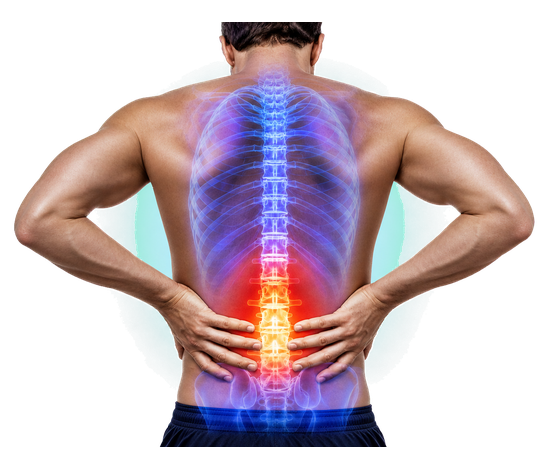

SPINE CONDITION

Spine & Back Pain

Back pain has a way of quietly taking things from you — the walk you used to take without thinking, the drive that didn't hurt, a full night's sleep. It can come from the discs, joints, nerves, or muscles that make up your spine, and it's one of the most common reasons people seek care — yet one of the most often mismanaged, because treatment usually starts before anyone figures out exactly what's causing it. But small changes can be the starting point of bigger problems years down the road, and treating your spine upstream — before a disc or joint fully breaks down — can change that trajectory and keep surgery off the table. At Wellward, we don't guess based on where it hurts or what the MRI shows. We find the real source first.

Does This Sound Familiar?

Back pain can feel sharp, dull, and aching all at once. It can radiate down your leg or wake you in the middle of the night — set off by bending over, rolling in bed, or seemingly nothing at all.

It doesn't just change how you move. It chips away at your confidence and how you picture your future. When you start compromising who you are because of it, it's time to get answers.

If several of the statements feel familiar, the next step is not guessing. It may be time for a more complete evaluation of what is actually driving your pain.

Do you…

If several of these feel familiar, the next step isn't guessing — it's a real answer.

  • Look for something to lean on when standing or talking with others?
  • Have walking or standing limited by pain?
  • Sacrifice parts of who you are because of unpredictable pain?
  • Plan your day around chairs, rest breaks, parking distance, or how long you'll be on your feet?
  • Feel like no one has fully explained why you feel as bad as you do?

What Causes Spine Pain?

Spine pain rarely comes from one thing. An old injury, poor movement patterns, or years of everyday wear can quietly overload your discs, joints, and ligaments — until one day something tips over into pain that won't let up.

Once that happens, your body starts protecting itself: shifting your weight, guarding certain movements, avoiding what hurts. That's a smart short-term response, but over time it just moves the load somewhere else — often to a part of your body that was never built to carry it. And confusingly, where you feel it may not be where the real problem is.

Disc-Related Pain

Bulging, herniated, or degenerated discs that irritate nearby nerves or lose their ability to absorb load.

Facet Joint Pain

Wear or inflammation in the small joints that stabilize each spinal segment, often worse with bending backward.

Sacroiliac Joint Pain

Instability or irritation where the spine meets the pelvis, often felt near the beltline or buttock.

Ligament or Soft Tissue Injury

Strain or laxity in the connective tissue that stabilizes the spine and causes muscle spasms.

Nerve Irritation

Compression or inflammation of spinal nerves, often producing pain that radiates into the hip, leg, or foot.

Muscle Spasms

Compensation patterns, weakness, or repetitive strain that place uneven load on muscles, triggering a spasm.

Related Conditions

Spine pain isn't one diagnosis — it's an umbrella that covers disc problems, SI joint pain, facet arthritis, spinal stenosis, and nerve irritation, and they can feel frustratingly similar. That overlap is exactly why so many people end up on a revolving door of steroid injections that ease pain for a while without ever addressing what's actually wrong.

Herniated Disc

Pain after lifting or twisting, often with nerve symptoms.

Learn More

Sciatica

Pain traveling from the low back into the buttock, leg, or foot.

Learn More

Sacroiliac Joint Pain

Pain near the beltline, buttock, or back of the pelvis.

Learn More

Spinal Stenosis

Pain or heaviness worse with standing or walking, often relieved by sitting.

Learn More

Degenerative Disc Disease

Gradual stiffness, aching, or recurrent flare-ups from disc breakdown.

Learn More

Facet Arthritis

Localized stiffness and pain, often worse in the morning or with extension.

Learn More

Compression Fracture

Sudden, severe pain after a fall, trauma, or in the setting of bone weakness.

Learn More

Rib Instability or Sprain

A sprained or arthritic rib doesn't just hurt at the spine — it can radiate around the chest.

Learn More

How Wellward Evaluates Spine Pain

We don't jump to treatment before we know what's actually driving your pain — not just where it is, but why. Every plan is built on four things:

Your Story

Your full history — what's been tried, what matters to you, what you want to get back to.

Movement & Load

How you move, and which movements bring the pain on.

Structure & Imaging

We review your imaging in context, sometimes adding live ultrasound [→ /diagnostics/ (Diagnostic Ultrasound)] to get a clearer look at your discs, joints, nerves, and soft tissue.

Pain Mapping

Our process for testing each possible cause directly [→ /diagnostics/ (Pain Mapping)] — numbing specific structures one at a time with diagnostic injections until we find the one actually responsible. Not a guess. Proof.

Treatment Pathways

Care follows your pain-mapped diagnosis — not a one-size-fits-all protocol.

Conservative

Rehab and hands-on manual therapy [→ /manual-movement-based-therapies/] come first whenever they can meaningfully change the outcome. When more is needed, we add targeted interventional procedures like blocks, epidurals, or nerve ablation [→ /interventional-pain/] to calm things down and get you moving again.

Regenerative & Stem Cell Therapy

For appropriate candidates, we use your own cells — drawn and prepared in-house the same day, no donor tissue, no waiting on a lab — alongside PRP and other orthobiologic injections [→ /regenerative-therapies/] to calm inflammation and support your natural repair process. Stem cell therapy isn't right for every diagnosis, which is why it's only offered once your evaluation confirms it's a genuine fit for your goals.

What Patients Experience

Real stories. Real outcomes.

Patient testimonial will be placed here.

John Carter
Businessman

Patient testimonial will be placed here.

John Carter
Businessman

Broader Support When Pain Goes Deeper

Global module — see style guide for card links. Only the intro line below is spine-specific.

When spine pain is persistent or life feels limited, additional support can help.

Warrior Program

Advanced support for complex tissue, nervous system sensitization, and persistent pain.

Learn More

Pain Coaching

One-on-one coaching to build resilience, improve habits, and restore confidence.

Learn More

Neural Reset Program

A science-based program to calm the nervous system and reduce chronic pain signals.

Learn More

Surgery or Urgent Evaluation

In some cases, surgery or urgent evaluation may be the safest or most appropriate path. We will help you understand all options

Learn More

Common Questions About Spine & Back Pain

Can an MRI be normal with spine or back pain?

Yes. Imaging is a helpful piece of the picture, but it doesn't always explain pain. Some painful structures don't show clearly on MRI, and some MRI findings show up in people with no symptoms at all. That's why we don't rely on imaging alone — it's one input into Pain Mapping, not the whole answer.

Does stem cell therapy work for spine pain?

For the right candidate, it can meaningfully support healing — but it's not for every patient or every diagnosis. Stem cell and other regenerative therapies are considered only after your evaluation confirms your tissue quality, diagnosis, and goals actually support that approach.

How do I know if my pain is coming from a disc, joint, or nerve?

Honestly, you often can't tell from symptoms alone — disc pain, facet joint pain, SI joint pain, and nerve irritation can all feel similar. That's what Pain Mapping is for: testing each possibility directly instead of guessing.

When is spine surgery necessary?

Usually only when there's real structural damage, a progressive nerve problem, severe compression, instability, or fracture — or when conservative and regenerative care genuinely hasn't moved the needle. Every case is different, and we'll be straight with you about which one you're in.

How much does spine pain treatment cost, and is it covered by insurance?

It depends on your diagnosis and what's recommended. Diagnostic and conservative care is often covered by insurance, while some regenerative and stem cell therapies are not. We'll walk through your options and costs on your discovery call, so there are no surprises before you start.

How soon can I get in to be seen?

Most new patients can schedule a discovery call within one business day. We know how derailing pain can be, so we work hard to get you seen within a week.

Ready to Understand What Is Driving Your Spine & Back Pain?

Take the next step toward lasting relief.

Take the Readiness Quiz

Find out if our approach is right for your condition.

Schedule a Discovery Call

Talk with our team and get answers to your questions.

Ready to Find Out What's Really Driving Your Back Pain?

Take the next step toward getting your life back.