
Percutaneous
Tenotomy
A minimally invasive, ultrasound-guided procedure to remove or disrupt unhealthy tendon tissue and create a new opportunity for healing.
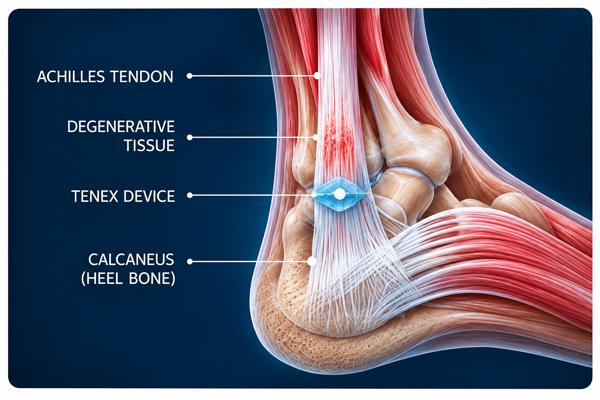
Some tendons remain painful because a focal area of chronically damaged tissue never reorganized into healthy, load-bearing tendon. Percutaneous tenotomy uses live ultrasound to identify and mechanically remove or disrupt that degenerative tissue through a very small opening—while preserving surrounding healthy tendon.
How It Works
Live ultrasound is used to locate the diseased portion of the tendon. Through a tiny skin opening, a specialized instrument (such as Tenex or TenJet) mechanically disrupts or removes the unhealthy tissue while preserving healthy tendon as much as possible.
Conditions We Treat
- Chronic tennis or golfer’s elbow
- Rotator cuff tendinopathy or selected partial tears
- Gluteus medius or minimus tendinopathy (greater trochanter)
- Patellar tendinopathy
- Achilles tendinopathy
- Plantar fascia degeneration
- Other focal tendon disease that has not improved with rehabilitation
Works Well With
Regenerative Care
Tenotomy and PRP or other regenerative treatments address different parts of the same problem. Tenotomy removes or disrupts unhealthy tissue, while PRP provides concentrated healing signals to support the recovery that follows. They may be performed together or in stages, depending on your tendon and goals.
Minimally Invasive
Recovery
No large incision or stitches. Most procedures are performed in the office with local anesthetic and, when appropriate, light sedation. Recovery includes a period of protection followed by progressive loading, strengthening, and return to work, recreation, or sport.
When Another Path May Be Better
Complete or significantly retracted tendon tears, major mechanical failure, infection, unstable injuries, or tendon damage unlikely to recover may require surgical evaluation. Pain that has not been clearly localized to the tendon should also be mapped before treatment.
Risks and Limitations
Temporary soreness, bruising, swelling, or an increase in pain is common. Improvement is gradual. Tenotomy cannot reliably reconnect a complete tear or overcome major mechanical failure. Bleeding, infection, nerve injury, or incomplete relief are uncommon but possible.
Common Areas We Treat
(rotator cuff)
Elbow
(gluteal tendons)
(patellar tendon)
Tendon
Frequently Asked Questions
No. It is a minimally invasive procedure performed through a very small opening under ultrasound guidance. It does not replace surgery when a tendon needs formal mechanical repair.
Yes. In selected degenerative tendons, tenotomy and PRP may be used together or staged because they address different parts of recovery: removing or disrupting unhealthy tissue and supporting the healing response that follows.
Tenex and TenJet are technologies that may be used to perform percutaneous treatment of selected degenerative tendon tissue. The specific technique is chosen according to the tendon, anatomy, and treatment goal.
When a Tendon Has Stalled, the Next Step May Be More Than Another Injection
Find out whether rehabilitation, regenerative treatment, percutaneous tenotomy, or a combination best fits the tendon that is actually limiting recovery.