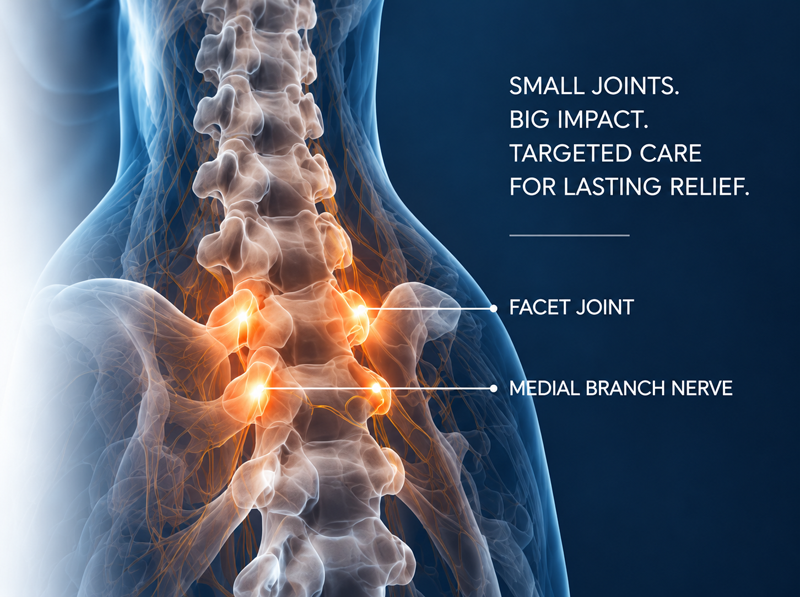
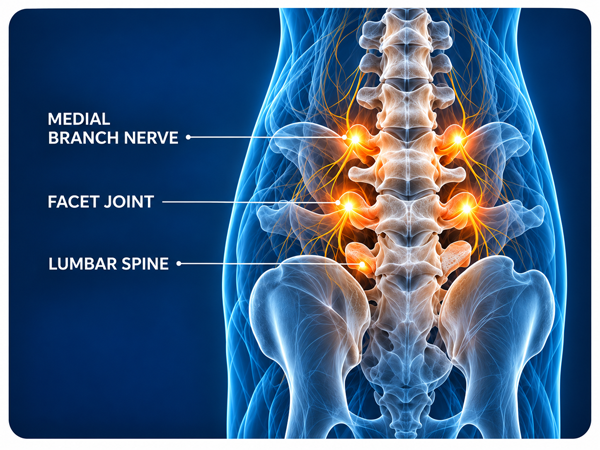
Facet joints are small paired joints that guide movement in the spine. When they become painful or arthritic, the discomfort may be felt across the neck, mid-back, low back, buttock, or nearby muscles. Because imaging alone cannot prove that a facet joint hurts, treatment usually begins with a diagnostic medial branch block.
A small amount of anesthetic is placed around the medial branch nerves that carry pain from the suspected facet joints. You then compare your usual pain and function before and after the procedure.
Step 2: Radiofrequency Ablation
When the diagnostic response supports facet-mediated pain, radiofrequency energy can be used to interrupt pain signaling from the selected medial branch nerves for a longer period.
What Treatment Is Like
Both procedures are performed with imaging guidance. You remain awake while the skin is numbed and a thin needle is guided to the small nerves beside the suspected joints. After a diagnostic block, you track whether familiar pain and movement improve. RFA is considered only when the block response shows those nerves are meaningful pain carriers.
When This Path May Fit
Chronic neck or back pain centered near the spine rather than traveling into an arm or leg
Pain worsened by extension, rotation, prolonged standing, or loading
Facet arthropathy that fits the clinical pattern
Meaningful temporary relief after the required diagnostic block or blocks
Could Regenerative Care Help?
Regenerative care may help fortify the disc, joint capsule, ligaments, and surrounding structures that contribute to facet overload. For selected patients, combining approaches can be useful: radiofrequency ablation may provide faster relief, while regenerative treatment and rehabilitation work toward better support and long-term function.
Risks and Limitations
Soreness, bruising, numbness, bleeding, infection, or medication reactions can occur. RFA may cause temporary increased pain, muscle spasm, or localized numbness. The treated nerves can recover over time, so pain may eventually return. These procedures reduce pain signaling rather than repairing the arthritic joint. When tissue damage or instability is also part of the problem, regenerative treatment may be considered alongside RFA or as part of a more structural recovery plan.