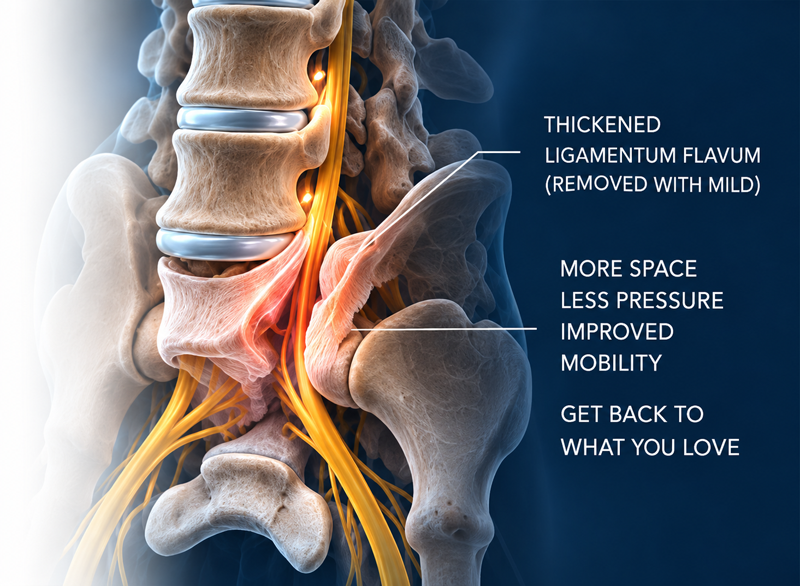
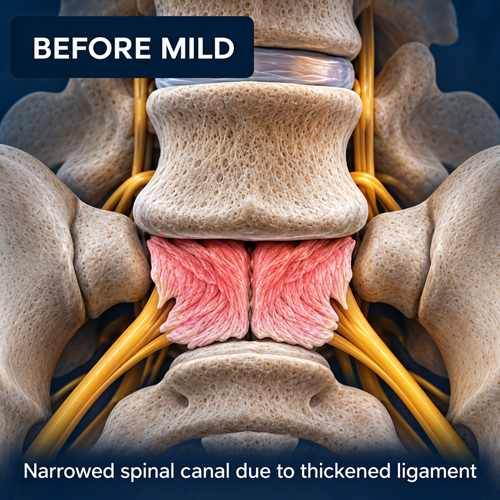
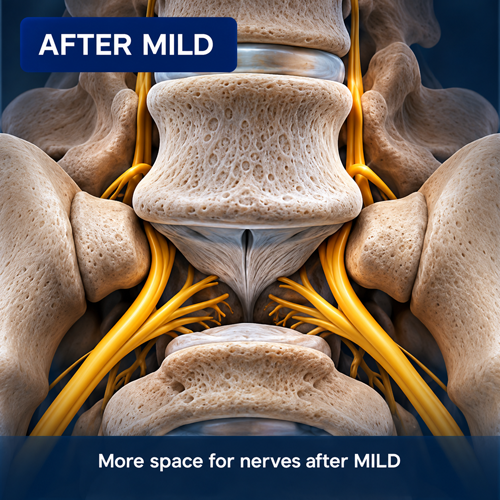
Removes excess, thickened ligament tissue (ligamentum flavum) that is narrowing your spinal canal, using a single small incision and imaging guidance.
What It’s Designed to Do
• Restore space in a narrowed spinal canal • Relieve pressure on compressed spinal nerves • Preserve spinal stability—no implant, minimal bone removal
When It May Be Appropriate
• Lumbar spinal stenosis on imaging with leg pain, heaviness or numbness worse with standing or walking • Symptoms improve with sitting or bending forward • Conservative care hasn’t lasted
When It May Not Be the Right Fit
• Stenosis caused primarily by bone rather than ligament thickening • Advanced instability or deformity • Multilevel disease better addressed surgically
How This Fits Into a Broader Plan
MILD is typically considered after Pain Mapping determines that stenosis is largely driven by ligament thickening, and before more invasive surgical decompression. It is an outpatient procedure, with most patients discharged the same day.
Could Regenerative Care Help?
In selected patients, regenerative care may address a repairable disc, facet capsule, ligament, or sacroiliac structure contributing to the unstable environment. Combining decompression with a stabilization-focused recovery plan may help improve function.
Risks and Limitations
MILD is most useful when thickened ligament tissue is an important reason the spinal canal has become crowded. It will not correct every form of stenosis, especially when narrowing is primarily caused by bone, major instability, or deformity. Most patients go home the same day, and recovery is generally much less disruptive than traditional decompression surgery. Temporary soreness is expected. Bleeding, infection, or nerve injury are uncommon but possible.
Unlike traditional decompression surgery, MILD doesn’t require cutting bone or placing an implant—it specifically targets and removes the thickened ligament tissue causing the narrowing, preserving your spine’s structural stability.
MILD is an outpatient procedure—most patients go home the same day and typically return to normal activities faster than with traditional decompression surgery.
Ready to Find Out If MILD (Minimally Invasive Lumbar Decompression) Fits Your Diagnosis?
A thorough evaluation can determine whether MILD is the right option for you.