
Kyphoplasty
Stabilize. Relieve Pain. Move Forward.
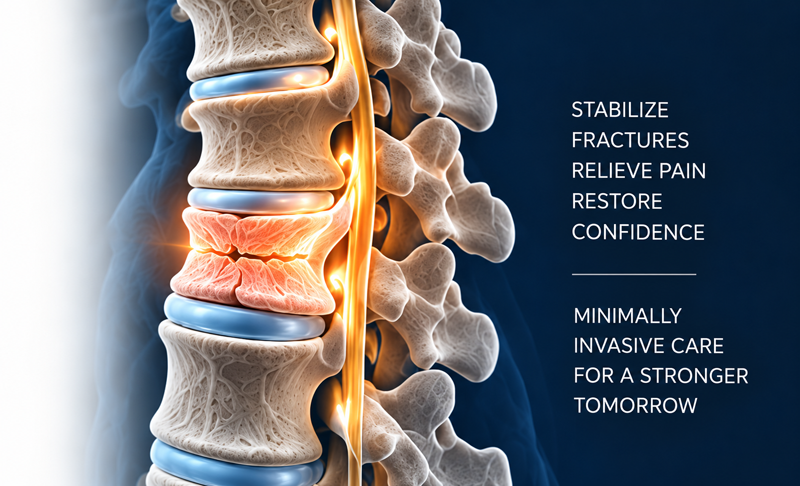
A vertebral compression fracture can feel catastrophic and makes any movement sharply painful. Kyphoplasty stabilizes the fracture from within without major surgery.
How the Procedure Works
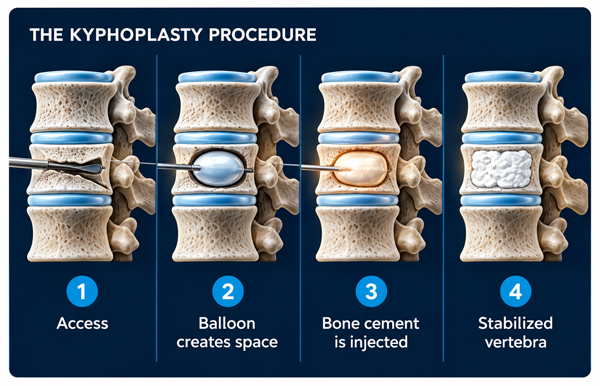
Through a small working channel placed under X-ray guidance, a balloon or other cavity-creating device is introduced into the fractured vertebral body. The space is then filled with bone cement to stabilize micro-motion. Some height or shape may be restored, but pain relief comes primarily from stabilization rather than cosmetic correction of the X-ray.
Who May Be a Candidate
• A recent or still-active painful compression fracture confirmed by imaging
• Pain that closely localizes to the fractured level
• Persistent limitation despite bracing, medication, and activity modification
• Osteoporotic or selected fractures when the clinical plan supports treatment
Why Timing and Imaging Matter
Old healed fractures may remain visible on X-ray but may no longer be the pain source. MRI or other imaging helps distinguish an active fracture from a chronic deformity and evaluates the posterior wall, canal, and nearby structures.
What Kyphoplasty Does Not Treat
• It does not treat every cause of back pain
• Does not correct osteoporosis
• Does not prevent future fractures by itself
• Bone-health evaluation, fall prevention, strength, nutrition, and osteoporosis treatment remain essential
Could Regenerative Care Help?
Kyphoplasty stabilizes an active compression fracture; regenerative care is not a substitute for that stabilization. After the fracture is secured, persistent pain may come from adjacent ligaments, facet joints, discs, or sacroiliac structures that were strained by the fracture. Where those tissues remain repairable, a separate regenerative plan may be considered together with bone-health treatment, strengthening, and fall prevention.
Risks and Limitations
Some bone cement can move outside the treated vertebra; most small leaks cause no symptoms. More significant complications—including infection, bleeding, nerve irritation, or cement affecting nearby structures—are uncommon. Kyphoplasty works best when the fracture is still active and is actually responsible for the pain. It also does not treat the underlying osteoporosis.
Related Conditions
Vertebral
Compression Fractures
Osteoporosis
Degenerative
Disc Disease
Spinal
Fractures
Chronic Back Pain
Post-Menopausal
Bone Health
Other Conditions
Frequently Asked Questions
Some patients notice improvement within days, while others recover more gradually. Pain from muscles, facets, or additional fractures may persist even after the treated vertebra is stabilized.
Both use bone cement. Kyphoplasty first creates a cavity, commonly with a balloon, while vertebroplasty injects cement without that step. The choice depends on anatomy and clinical judgment.
Is the Fracture Still Active—and Is It the Pain Source?
Those two questions should be answered before cement is placed.