
Knee Replacement
Alternatives
If you have been told knee replacement may be next, the most useful question is not simply how to avoid surgery. It is whether the knee is already too damaged to preserve—or whether there is still a reasonable opportunity to improve pain and function without replacing it.
At Wellward, We Look at the Whole Knee
We look beyond the amount of arthritis on an X-ray. We evaluate the joint and the structures that support it to understand what is failing, what is still repairable, and which options are realistic.
More than
an X-ray
Identify the
real source
Preserve
when possible
A plan that
fits your goals
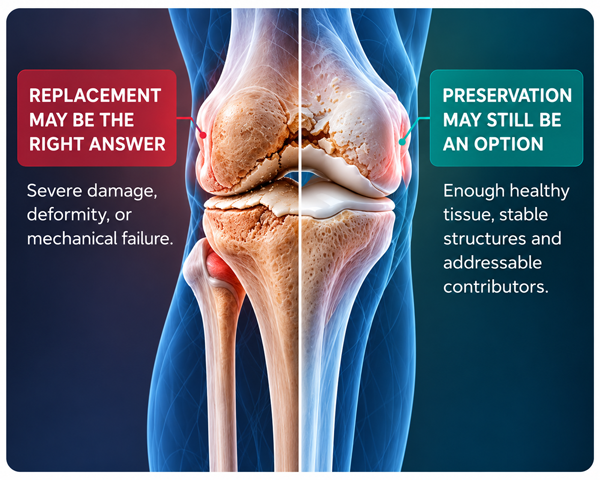
When Knee Replacement May Be the Right Answer
Severe deformity, advanced loss of joint structure, major mechanical failure, or a knee that no longer functions reliably may be better treated with replacement.
What We Look for Before You Decide
Two people can have similar arthritis on imaging and very different reasons for hurting. Pain mapping helps determine how much pain is coming from the joint itself and whether the meniscus, ligaments, tendons, kneecap mechanics, alignment, or instability are adding to the problem.
- How advanced is the joint damage?
- Are tendons or the kneecap overloaded?
- Are the supporting ligaments stable?
- Can movement and loading be improved?
- Is the meniscus contributing?
- Is there enough healthy tissue left?
What Non-Surgical Options May Include
Depending on what is found, the plan may include progressive rehabilitation, targeted joint or surrounding-tissue injections, PRP or another regenerative treatment, and treatment of specific mechanical or soft-tissue problems.

Targeted Rehabilitation
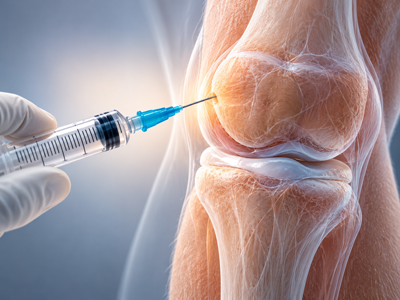
Joint Injections
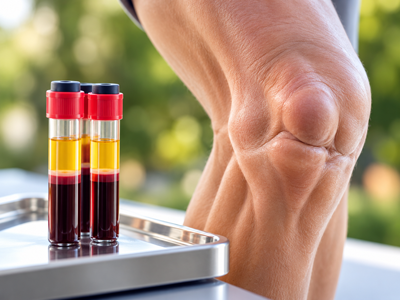
Regenerative Treatments

Treating Specific Issues
Repeated Injections Can Help—But They Do Not All Have the Same Goal
Steroid and hyaluronic-acid injections can be useful tools. They may reduce pain, improve movement, and help some patients remain functional longer before surgery becomes necessary. But they are primarily symptom-management strategies; they do not rebuild a worn joint or correct a ligament, tendon, meniscus, or stability problem.
A Different Question with Regenerative Care
Regenerative care asks whether there is still tissue worth supporting or reinforcing. For selected patients, PRP or another regenerative approach may be used not only inside the joint but also in the structures that help the knee distribute load.
Who May Still Have a Reasonable Non-Surgical Window
How We Decide
Pain mapping may combine examination, movement and load testing, ultrasound, review of prior imaging, and selected diagnostic injections. The purpose is to estimate whether there is a realistic opportunity to improve the knee before asking you to invest the time, recovery, and cost involved.
Related Paths
- Knee Conditions →
- Diagnostics & Pain Mapping →
- PRP & Regenerative Treatment →
- Joint Injections →
- Manual & Movement-Based Care →
NOT SURE WHETHER YOU ARE REALLY AT THE REPLACEMENT STAGE?
Find Clarity About Your Next Step
An evaluation can help clarify what is still repairable, what is driving the pain, and whether a reasonable joint-preservation window remains.