
Back Pain & Spine:
PRP & Regenerative
Treatment
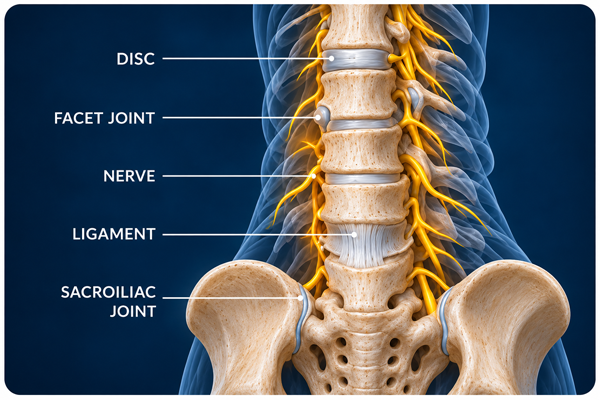
“Back pain” is not one diagnosis. A disc, facet joint, ligament, sacroiliac structure, irritated nerve, or several of these can produce similar symptoms. Regenerative spine care only makes sense when we know which structure is actually limiting recovery. Pain Mapping helps us identify the real source of your pain and whether a non-surgical option is a realistic alternative.
PRP & Regenerative
Treatment for Back Pain
PRP may be used in selected spinal structures when the tissue remains capable of healing. Depending on the diagnosis, treatment may involve discs, facet joints, ligaments, sacroiliac structures, or selected nerve-related applications. More advanced options such as BMAC may be considered for selected disc or bone-related problems.
Why Pain Mapping
Matters
Spinal MRIs commonly show abnormalities in people who have no pain. Pain Mapping combines your history, examination, movement testing, imaging review, and diagnostic procedures to determine which structure is actually causing your symptoms.
Conditions We May
Evaluate
- Disc-related pain
- Facet-joint pain
- Sacroiliac joint dysfunction
- Ligament and capsule injury
- Nerve-related pain
- Instability or mechanical overload
When Regenerative
Care May Fit
- Pain localized to a specific structure
- Symptoms persist despite rehabilitation
- No urgent surgical indication
- Tissue remains a reasonable target for healing
- You can participate in the recovery plan
When Another Path May Be Better
Recovery Is Part of the Treatment
Risks and Limitations
Temporary soreness or an increase in back or nerve-related symptoms can occur. Results depend on the type and stage of the problem, the structures involved, overall health, and rehabilitation. Regenerative treatment cannot reliably rebuild a severely damaged disc or correct major instability. Bleeding, infection, nerve irritation, or injury to nearby structures are uncommon but possible.
Frequently Asked Questions
No injection can guarantee that a degenerated disc will be rebuilt. The more realistic question is whether a selected disc or supporting structure still has enough biological and mechanical capacity to improve pain and function.
Because abnormal discs are common even in people without pain. The imaging needs to match the history, examination, and diagnostic findings before an invasive regenerative procedure is considered.
Yes. In selected cases, an interventional procedure may reduce pain or decompress a nerve while regenerative care addresses a repairable disc, ligament, joint capsule, or SI structure contributing to the broader problem.
Start by finding out whether the pain is coming from the disc, joint, ligament, nerve, SI region—or several of them together.
Researching PRP or Stem Cell Treatment for Back Pain?
Start by finding out whether the pain is coming from the disc, joint, ligament, nerve, SI region—or several of them together.