
Prolotherapy
Some pain persists because a ligament or tendon attachment remains weak, lax, or chronically irritated—not because inflammation needs to be suppressed again. Prolotherapy uses a concentrated dextrose solution to stimulate a controlled local repair response at the tissue that has failed to recover.
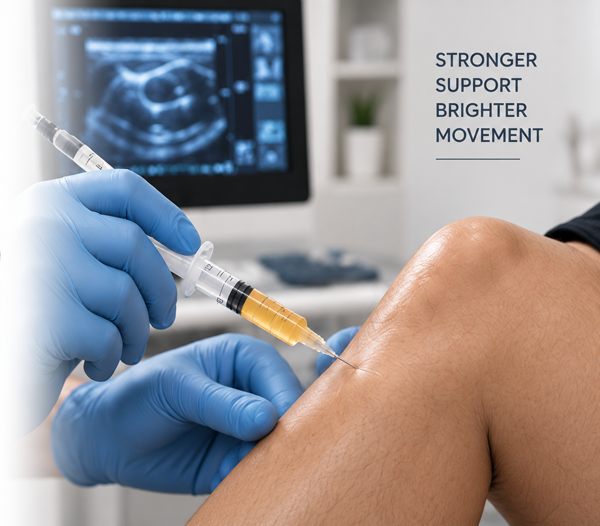
Where Prolotherapy Is Most Useful
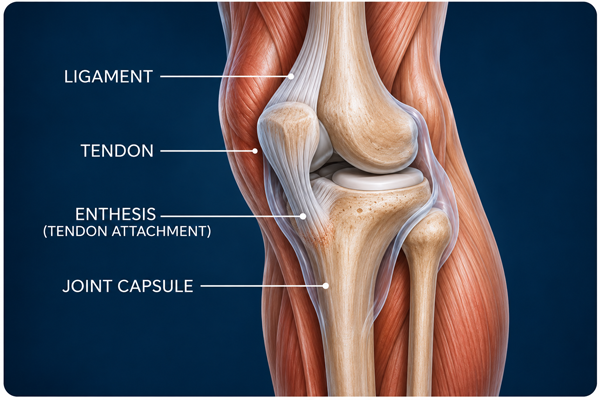
Prolotherapy is often directed to ligament attachments, tendon insertions, joint capsules, or small areas of instability. It is less about filling the center of a joint and more about improving the support structures that guide and stabilize it.
How It Works
Dextrose is injected under image guidance into the selected target. The solution changes the local cellular environment and stimulates a brief healing response. Treatment is usually performed as a series because the goal is gradual tissue adaptation rather than immediate anesthesia.
When It May Be Considered
- Ligament laxity or chronic sprain
- Tendon or ligament attachment pain where a tendon or ligament attaches to bone
- Joint pain linked to capsular weakness or mild instability
- Tendon pain that has plateaued despite appropriate loading
- A lower-intensity or lower-cost biologic option is reasonable for the tissue involved
What It Is Not
Prolotherapy is not simply “sugar water for arthritis,” and it is not automatically the weakest step before PRP. In selected ligament and attachment problems, dextrose may be the treatment that best matches the biology and the amount of stimulation needed.
Recovery and Rehabilitation
Temporary soreness is expected and may last several days. The treated structure usually needs protection followed by progressive loading. Repeated use of anti-inflammatory medication may be discouraged around treatment depending on the clinical plan.
When It May Not Be the Right Fit
Prolotherapy may offer limited value when there is a complete tear, severe arthritis, major deformity, infection, an urgent surgical problem, or pain that has not been linked to a specific ligament, tendon, or joint-support structure.
How This Fits Into a Broader Plan
Prolotherapy is often paired with gradual strengthening, movement retraining, and treatment of nearby structures that continue to overload the painful ligament or tendon. The injection may stimulate a repair response, but the tissue still needs the right amount of protection and progressive load to become stronger.
Risks and Limitations
Temporary soreness for several days is expected because prolotherapy is intended to stimulate a healing response rather than immediately numb the area.
Improvement is gradual, and more than one treatment may be needed. Results are less predictable when there is advanced arthritis, a complete tear, or major mechanical failure that the tissue cannot reasonably overcome.
Frequently Asked Questions
A series of treatments spaced several weeks apart is common, but the number depends on the tissue, severity, response, and rehabilitation progress.
It is usually self-pay. Costs and alternatives are reviewed before treatment.
PRP Is a Preparation—not a Complete Treatment Plan
The value comes from matching the preparation, target, and recovery plan to the tissue that needs help.