RECOVERY SUPPORT—MANUAL & MOVEMENT-BASED CARE
Manual &
Movement-Based Care
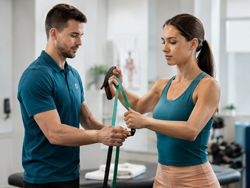
A regenerative injection may create a new opportunity for healing, but the tissue still has to be trained into something stronger. Manual and movement-based care helps translate reduced pain or improved tissue biology into resilient, confident function.
It may begin before a procedure, run alongside it, or become the primary treatment when movement and loading are the main needs.
What This Includes
Physical Therapy &
Orthobiologic Rehabilitation
Personalized strengthening, mobility, and progressive loading built around what was actually diagnosed and treated—not a generic protocol.
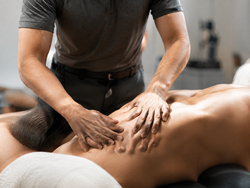
Chiropractic &
Manual Therapy
Hands-on care coordinated through Wellward or trusted partners to improve motion, reduce protective guarding, and address mechanical restrictions that may interfere with recovery.
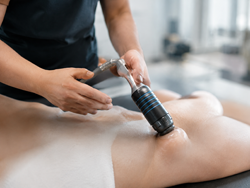
Extracorporeal
Shockwave Therapy
Focused acoustic energy used for selected chronic tendon, fascia, and soft-tissue problems to stimulate a new healing response and improve tissue quality.
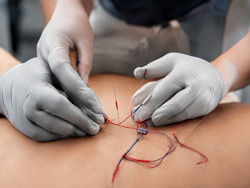
Electrical
Dry Needling
Thin needles and electrical stimulation target selected trigger points, muscle guarding, and myofascial pain while supporting improved activation and movement.
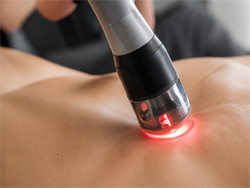
MLS Laser
Therapy
Therapeutic light may be used to reduce pain and inflammation and support recovery, often as one part of a broader rehabilitation plan.
How This Is Coordinated
The plan is matched to the diagnosis, the tissue treated, and the stage of healing. Too little loading can lead to deconditioning; too much, too soon can aggravate the tissue.
We coordinate timing, protection, mobility, strengthening, and return to activity so rehabilitation progresses with the biology rather than against it.
When to Consider Manual & Movement-Based Care
- Pain or weakness is limiting normal movement
- A joint, tendon, ligament, or spinal structure needs progressive loading
- Compensation and guarding remain after an injury or procedure
- A treatment created relief, but confidence and function have not fully returned
- Movement mechanics are contributing to repeated irritation
What to Expect
Recovery is progressive rather than passive. The plan may begin with protection and symptom control, then advance through mobility, tissue loading, strength, movement quality, and real-world activity. Progress is adjusted according to tissue response—not forced through a fixed timeline.
Protection &
Symptom Control
Mobility
Tissue
Loading
Strength
Movement
Quality
Real-World
Activity
How It Fits Into Broader Care
Manual and movement-based care can be the primary treatment or can support interventional and regenerative care from day one.
Its purpose is not simply to make a painful area feel looser for a few hours; it is to help the body use the opportunity created by treatment and carry those gains into daily life.
Ready to Turn Relief Into Resilience?
Build the movement, strength, and confidence needed to support lasting progress.